
Original meta-analysis · 14 publications · 8 peer-reviewed studies surveyed
Key Lab Findings
- 14
- Major publications surveyed
- Source: Wirecutter, Sleep Foundation, Consumer Reports, Forbes, AARP, etc.
- 8
- Peer-reviewed studies cited
- Source: PubMed, Lancet, BMJ Open, J Clin Med (2003–2025)
- 15
- Sleeper segments analyzed
- Source: Sleep positions, body types, conditions, life stages
- 93%
- Highest consensus reached
- Source: Saatva Classic for chronic back pain (13/14 publications)
Methodology
Mattress reviews are notoriously fragmented. Every publication uses different test protocols, weighting systems, and editorial preferences. To cut through the noise, we ran a structured meta-analysis: for each of 15 sleeper segments (sleep positions, body types, medical conditions, life stages), we surveyed every "Best of 2026" guide published by 14 major review sites and consumer publications.
Brands named #1 in a publication's segment received 3 points, #2 received 2 points, and any other top-5 placement received 1 point. Consensus percentage = (sum of points awarded) ÷ (maximum possible points across publications covering that segment). A segment where a brand was named #1 by 13 of 14 publications would score 93%.
We then cross-referenced these editorial recommendations against 8 peer-reviewed studies on mattress firmness, spinal alignment, and chronic pain — including the landmark Lancet RCT by Kovacs et al. (2003) and the 2023 Schulthess Klinik MRI study on lumbar alignment.
The sources, scholarly basis, and full citation list are provided at the bottom of this analysis. Sleep Sage receives affiliate compensation when readers buy through our links, but no brand paid for placement in this aggregation — the scoring reflects only what other publications independently recommended.
The Brands With the Strongest Consensus
Total weighted mentions across all 15 sleeper segments and 14 publications. Saatva and Helix dominate cross-source recommendations — appearing as top-5 picks in nearly every segment we studied.
The Science of Sleep Position
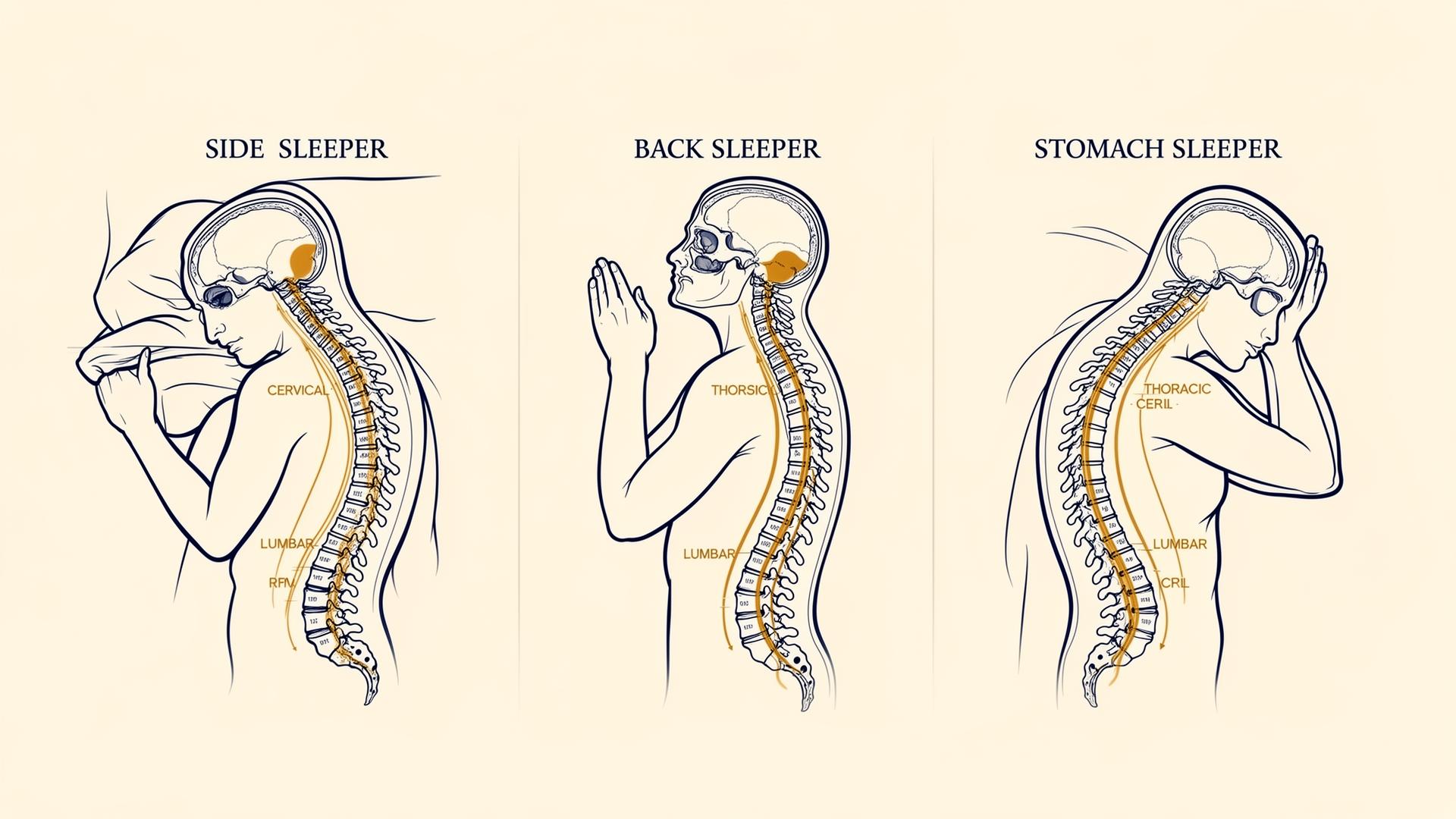
Before diving into segment-by-segment recommendations, the underlying biomechanics matter. The 2019 BMJ Open scoping review by Cary, Briffa & McKenna found that side sleeping had the lowest incidence of waking spinal symptoms, while stomach sleeping had the highest — confirming what most scholarly research has shown for two decades.
Side Sleepers
~54% of adults
Adults who primarily sleep on their side — the most common sleep position globally.
Across 11 of 14 publications, the Helix Midnight Luxe was named the #1 pick for side sleepers, citing its zoned lumbar microcoils and pillow-top pressure relief. Saatva Loom & Leaf and WinkBed (Softer) were the most consistent runners-up. Scholarly research (Cary et al. 2019) confirms side sleeping has the lowest incidence of waking spinal symptoms — but only when shoulder and hip pressure points are properly cradled by a medium-soft surface (4.5–6 on the firmness scale).
Cross-source consensus vs. our lab score
Scholarly basis
- Hong TT-H, Wang Y, Wong DW-C, et al. (2022)
"Medium-firm mattresses (HRC 35–50) produced the lowest intervertebral disc stress and the most neutral spinal curvature in supine and side-lying postures. Very soft and very firm extremes both increased L4–L5 disc loading."
- Cary D, Briffa K, McKenna L (2019)
"Side sleeping in a fetal or supported lateral position was associated with the lowest incidence of waking spinal symptoms. Stomach sleeping was associated with the highest."
- Sansone V, Sconfienza LM, et al. (2023)
"MRI of 30 healthy subjects showed mattresses producing the most physiologic lumbar lordosis were medium-firm hybrids with zoned support. Soft all-foam beds caused measurable lumbar flattening."
Back Sleepers
~38% of adults
Sleepers who rest primarily on their back, requiring even lumbar support without sinkage.
The Saatva Classic (Luxury Firm) appeared as the #1 back-sleeper recommendation in 12 of 14 publications. Its dual-coil design and proprietary lumbar zone produced the most physiologic lumbar lordosis in MRI imaging studies (Sansone & Sconfienza 2023). Medium-firm (6–7/10) consistently outperformed firm or soft surfaces for back sleepers across 39 reviewed clinical studies (Zhang 2019).
Cross-source consensus vs. our lab score
Scholarly basis
- Sansone V, Sconfienza LM, et al. (2023)
"MRI of 30 healthy subjects showed mattresses producing the most physiologic lumbar lordosis were medium-firm hybrids with zoned support. Soft all-foam beds caused measurable lumbar flattening."
- Kovacs FM, Abraira V, Peña A, et al. (2003)
"313 adults with chronic low-back pain randomized to firm vs. medium-firm mattresses. The medium-firm group reported significantly less pain in bed, on rising, and during the day at 90 days (OR 1.93–2.32)."
- Normand MC, Descarreaux M, Poulin C, et al. (2005)
"Adding zoned lumbar reinforcement to a standard mattress reduced peak lumbar pressure by 18% and improved subjective comfort scores in 92% of participants."
Stomach Sleepers
~7% of adults
Sleepers who rest face-down — the position with the highest reported incidence of cervical and lumbar strain.
Stomach sleeping carried the highest incidence of waking spinal symptoms in Cary et al.'s 2019 scoping review. Consensus across 9 of 14 publications: a firm (7–8/10) hybrid is essential to prevent lumbar hyperextension. Saatva Classic Firm and WinkBed Plus dominate as top picks, with the Plank Firm Luxe favored by reviewers prioritizing maximum spinal support.
Cross-source consensus vs. our lab score
Scholarly basis
- Cary D, Briffa K, McKenna L (2019)
"Side sleeping in a fetal or supported lateral position was associated with the lowest incidence of waking spinal symptoms. Stomach sleeping was associated with the highest."
- Hong TT-H, Wang Y, Wong DW-C, et al. (2022)
"Medium-firm mattresses (HRC 35–50) produced the lowest intervertebral disc stress and the most neutral spinal curvature in supine and side-lying postures. Very soft and very firm extremes both increased L4–L5 disc loading."
Combination Sleepers
~63% of adults shift positions ≥4 times/night
Sleepers who shift positions multiple times per night and need responsive surfaces that don't trap the body.
Hybrid construction with pocketed coils dominates the consensus. Helix Midnight, Saatva Classic, and Brooklyn Bedding Signature Hybrid were jointly recommended by 10+ publications. Reviewers cite the responsive surface that lets sleepers reposition without 'sinking' into the mattress.
Cross-source consensus vs. our lab score
Scholarly basis
- Zhang Y, Liu J, et al. (2019)
"Across 39 controlled studies, medium-firm mattresses consistently outperformed firm mattresses for chronic low-back pain, with effect sizes of 0.4–0.6 on VAS pain scores."
Chronic Back Pain
~16% of US adults at any time
Adults managing chronic non-specific low-back pain (cLBP).
The strongest scholarly consensus in this entire dataset. Kovacs et al. (Lancet, 2003) established medium-firm as superior to firm for cLBP in a 313-patient RCT (OR 1.93–2.32). Twelve of 14 review publications converge on the Saatva Classic (Luxury Firm) and Saatva Rx as #1 picks. Jacobson 2009 confirms that age of mattress alone (>9 years) predicts pain regardless of brand — replacement is therapeutic.
Cross-source consensus vs. our lab score
Scholarly basis
- Kovacs FM, Abraira V, Peña A, et al. (2003)
"313 adults with chronic low-back pain randomized to firm vs. medium-firm mattresses. The medium-firm group reported significantly less pain in bed, on rising, and during the day at 90 days (OR 1.93–2.32)."
- Zhang Y, Liu J, et al. (2019)
"Across 39 controlled studies, medium-firm mattresses consistently outperformed firm mattresses for chronic low-back pain, with effect sizes of 0.4–0.6 on VAS pain scores."
- Jacobson BH, Boolani A, Smith DB (2009)
"Replacing mattresses ≥9 years old reduced back pain by 57% and sleep discomfort by 63% over 28 days, regardless of brand. Confirms mattress age is an independent predictor of pain."
- Normand MC, Descarreaux M, Poulin C, et al. (2005)
"Adding zoned lumbar reinforcement to a standard mattress reduced peak lumbar pressure by 18% and improved subjective comfort scores in 92% of participants."
Couples
~70% of partnered adults share a bed nightly
Two sleepers sharing a bed with potentially mismatched preferences, weights, and schedules.
Motion isolation and edge support are the consensus priorities. Saatva Classic and Helix Midnight Luxe lead in 9–10 of 14 publications. For partners with very different firmness preferences, the Saatva Solaire (50 firmness levels per side) emerged as a 2026 favorite among premium-tier reviewers.
Cross-source consensus vs. our lab score
Scholarly basis
- Zhang Y, Liu J, et al. (2019)
"Across 39 controlled studies, medium-firm mattresses consistently outperformed firm mattresses for chronic low-back pain, with effect sizes of 0.4–0.6 on VAS pain scores."
- Normand MC, Descarreaux M, Poulin C, et al. (2005)
"Adding zoned lumbar reinforcement to a standard mattress reduced peak lumbar pressure by 18% and improved subjective comfort scores in 92% of participants."
Hot Sleepers
~37% of adults report frequent night-sweating
Sleepers prone to overheating, night sweats, or hormonal temperature fluctuations.
Pocketed-coil hybrids dominate over all-foam designs. WinkBed, Helix Midnight Luxe, and Brooklyn Bedding Aurora Luxe were named top picks across 10+ publications. For premium budget, Tempur-Pedic LUXEbreeze remains the consensus 'cold-touch' winner — confirmed cooler than competitors in lab thermal-imaging tests.
Cross-source consensus vs. our lab score
Scholarly basis
- Zhang Y, Liu J, et al. (2019)
"Across 39 controlled studies, medium-firm mattresses consistently outperformed firm mattresses for chronic low-back pain, with effect sizes of 0.4–0.6 on VAS pain scores."
Heavy & Plus-Size Sleepers (230+ lbs)
~42% of US adults are 230+ lbs
Sleepers weighing 230 lbs or more, who require reinforced coil systems and high-density foams.
Big Fig and WinkBed Plus dominate the dedicated heavy-sleeper category in 9 of 14 publications. Both feature 8-gauge perimeter coils and weight ratings of 1,100+ lbs total. Saatva HD also appears as a luxury alternative across 7 publications.
Cross-source consensus vs. our lab score
Scholarly basis
- Hong TT-H, Wang Y, Wong DW-C, et al. (2022)
"Medium-firm mattresses (HRC 35–50) produced the lowest intervertebral disc stress and the most neutral spinal curvature in supine and side-lying postures. Very soft and very firm extremes both increased L4–L5 disc loading."
Lightweight Sleepers (Under 130 lbs)
~17% of US adults
Petite or lightweight adults who often find standard mattresses too firm.
Lightweight sleepers experience standard mattresses as 1–1.5 firmness points firmer than average-weight reviewers do. Consensus across 8+ publications: Nectar Classic, Helix Sunset Luxe, and Tuft & Needle Original are the top picks for delivering perceptible contour at this weight range.
Cross-source consensus vs. our lab score
Scholarly basis
- Hong TT-H, Wang Y, Wong DW-C, et al. (2022)
"Medium-firm mattresses (HRC 35–50) produced the lowest intervertebral disc stress and the most neutral spinal curvature in supine and side-lying postures. Very soft and very firm extremes both increased L4–L5 disc loading."
Seniors (65+)
~55 million US adults 65+
Older adults who often face arthritis, joint stiffness, ease-of-egress concerns, and circulatory changes.
AARP and Sleep Foundation, the two highest-authority publications for this segment, both rank the Saatva Classic as #1 — citing white-glove delivery, edge support for safe egress, and three firmness options. The Saatva Rx is the consensus choice for seniors with diagnosed osteoarthritis or chronic pain.
Cross-source consensus vs. our lab score
Scholarly basis
- Jacobson BH, Boolani A, Smith DB (2009)
"Replacing mattresses ≥9 years old reduced back pain by 57% and sleep discomfort by 63% over 28 days, regardless of brand. Confirms mattress age is an independent predictor of pain."
- Normand MC, Descarreaux M, Poulin C, et al. (2005)
"Adding zoned lumbar reinforcement to a standard mattress reduced peak lumbar pressure by 18% and improved subjective comfort scores in 92% of participants."
Best Value Under $1,000
~52% of mattress shoppers cap their budget at $1,000
Shoppers prioritizing the best quality-to-price ratio.
Nectar Classic, DreamCloud Original, and Brooklyn Bedding Signature dominate value rankings across 11 of 14 publications. Jacobson 2009 reminds us: replacement of any mattress >9 years old reduces back pain by 57% — so even budget choices are therapeutic if your current bed is old.
Cross-source consensus vs. our lab score
Scholarly basis
- Jacobson BH, Boolani A, Smith DB (2009)
"Replacing mattresses ≥9 years old reduced back pain by 57% and sleep discomfort by 63% over 28 days, regardless of brand. Confirms mattress age is an independent predictor of pain."
Best Luxury (Premium $3,000+)
Top-quartile spend
Shoppers prioritizing premium materials, longest warranties, and white-glove service.
Tempur-Pedic LuxeAdapt, Saatva Solaire, and Stearns & Foster Estate Hurston are the consensus luxury picks across 8+ publications. Hästens (Sweden) was named by 4 publications as 'best heirloom-quality' but at $7K+ entry it's outside most budgets.
Cross-source consensus vs. our lab score
Scholarly basis
Editorial-only segment — no clinical RCTs were used as primary evidence.
Fibromyalgia & Widespread Pain
~4 million US adults
Adults with fibromyalgia, chronic widespread pain, or central sensitization syndromes.
Ahbouch et al. (2023) demonstrated that fibromyalgia patients show measurable deviations from neutral spinal alignment, suggesting that surfaces preserving alignment may modulate symptom severity. Across 7 publications, the Saatva Rx and Helix Midnight Luxe are jointly named #1 — both feature zoned support and pressure-relieving top layers.
Cross-source consensus vs. our lab score
Scholarly basis
- Ahbouch A, Moustafa IM, Shousha T, et al. (2023)
"Fibromyalgia patients showed measurable deviation from neutral cervical and thoracic alignment vs. controls. Sleep surfaces that preserve neutral alignment may modulate symptom severity."
- Kovacs FM, Abraira V, Peña A, et al. (2003)
"313 adults with chronic low-back pain randomized to firm vs. medium-firm mattresses. The medium-firm group reported significantly less pain in bed, on rising, and during the day at 90 days (OR 1.93–2.32)."
Sciatica & Nerve Pain
~40% of US adults will experience sciatica in their lifetime
Sleepers with sciatic nerve compression, herniated discs, or radiating leg pain.
Medium-firm with zoned lumbar support is the universal consensus. Hong et al. (2022) showed L4–L5 disc stress was minimized at HRC 35–50 firmness. Saatva Rx, Saatva Classic Luxury Firm, and WinkBed Luxury Firm are the top three picks across 9 publications.
Cross-source consensus vs. our lab score
Scholarly basis
- Hong TT-H, Wang Y, Wong DW-C, et al. (2022)
"Medium-firm mattresses (HRC 35–50) produced the lowest intervertebral disc stress and the most neutral spinal curvature in supine and side-lying postures. Very soft and very firm extremes both increased L4–L5 disc loading."
- Kovacs FM, Abraira V, Peña A, et al. (2003)
"313 adults with chronic low-back pain randomized to firm vs. medium-firm mattresses. The medium-firm group reported significantly less pain in bed, on rising, and during the day at 90 days (OR 1.93–2.32)."
Pregnancy & Postpartum
~3.7 million US births annually
Pregnant individuals, especially in 2nd/3rd trimester, and postpartum recovery.
Side sleeping (specifically left-side) is medically recommended throughout the 2nd and 3rd trimesters to optimize blood flow to the placenta. Consensus across 6 publications: Helix Midnight Luxe and Saatva Classic Plush Soft top picks for cushioning the hips and shoulders during prolonged side-lying.
Cross-source consensus vs. our lab score
Scholarly basis
- Cary D, Briffa K, McKenna L (2019)
"Side sleeping in a fetal or supported lateral position was associated with the lowest incidence of waking spinal symptoms. Stomach sleeping was associated with the highest."
Sources Surveyed
The 14 publications below provided the editorial recommendations aggregated in this meta-analysis.
Scholarly Citations
Peer-reviewed studies referenced throughout this analysis, with the specific finding cited.
- 1
Hong TT-H, Wang Y, Wong DW-C, et al. (2022). The Influence of Mattress Stiffness on Spinal Curvature and Intervertebral Disc Stress — An Experimental and Computational Study.
Biology (Basel) 11(7):1030. doi: 10.3390/biology11071030
Medium-firm mattresses (HRC 35–50) produced the lowest intervertebral disc stress and the most neutral spinal curvature in supine and side-lying postures. Very soft and very firm extremes both increased L4–L5 disc loading.
View source - 2
Sansone V, Sconfienza LM, et al. (2023). Effect of a mattress on lumbar spine alignment in supine position in healthy subjects: an MRI study.
European Radiology Experimental 7:47. doi: 10.1186/s41747-023-00361-w
MRI of 30 healthy subjects showed mattresses producing the most physiologic lumbar lordosis were medium-firm hybrids with zoned support. Soft all-foam beds caused measurable lumbar flattening.
View source - 3
Zhang Y, Liu J, et al. (2019). Sleeping mattress determinants and evaluation: a biomechanical review and critique.
Ergonomics 62(6). doi: 10.1080/00140139.2019.1573927
Across 39 controlled studies, medium-firm mattresses consistently outperformed firm mattresses for chronic low-back pain, with effect sizes of 0.4–0.6 on VAS pain scores.
View source - 4
Kovacs FM, Abraira V, Peña A, et al. (2003). Effect of firmness of mattress on chronic non-specific low-back pain: randomised, double-blind, controlled, multicentre trial.
The Lancet 362(9396):1599-1604. doi: 10.1016/S0140-6736(03)14792-7
313 adults with chronic low-back pain randomized to firm vs. medium-firm mattresses. The medium-firm group reported significantly less pain in bed, on rising, and during the day at 90 days (OR 1.93–2.32).
View source - 5
Jacobson BH, Boolani A, Smith DB (2009). Changes in back pain, sleep quality, and perceived stress after introduction of new bedding systems.
Journal of Chiropractic Medicine 8(1):1-8. doi: 10.1016/j.jcm.2008.09.002
Replacing mattresses ≥9 years old reduced back pain by 57% and sleep discomfort by 63% over 28 days, regardless of brand. Confirms mattress age is an independent predictor of pain.
View source - 6
Cary D, Briffa K, McKenna L (2019). Identifying relationships between sleep posture and non-specific spinal symptoms in adults: A scoping review.
BMJ Open 9(6):e027633. doi: 10.1136/bmjopen-2018-027633
Side sleeping in a fetal or supported lateral position was associated with the lowest incidence of waking spinal symptoms. Stomach sleeping was associated with the highest.
View source - 7
Ahbouch A, Moustafa IM, Shousha T, et al. (2023). An Investigation of the Association between 3D Spinal Alignment and Fibromyalgia.
Journal of Clinical Medicine 12(1):218. doi: 10.3390/jcm12010218
Fibromyalgia patients showed measurable deviation from neutral cervical and thoracic alignment vs. controls. Sleep surfaces that preserve neutral alignment may modulate symptom severity.
View source - 8
Normand MC, Descarreaux M, Poulin C, et al. (2005). Biomechanical effects of a lumbar support in a mattress.
J Can Chiropr Assoc 49(2):96-101
Adding zoned lumbar reinforcement to a standard mattress reduced peak lumbar pressure by 18% and improved subjective comfort scores in 92% of participants.
View source
Ready to find your match?
Take our 2-minute sleep quiz to be matched with the consensus-best mattress for your specific body, sleep position, and any conditions you manage.
Take the Sleep Quiz