Research evaluation · October 10, 2026
Night Air Mattress Review: Is Boyd's Adjustable Air Bed Worth It?
Night Air is Boyd Sleep's alternative to fixed-firmness foam, innerspring and latex beds. Its Smart Zone mattresses use adjustable air chambers and two included wired controls to change the support level on either side. The key buying decision is whether you need two zones for couples or six zones with independent lumbar adjustment—and which comfort layer belongs on top.
Our review methodology
This is a research-based review, not hands-on testing. We checked Night Air's current product listings, trial terms, shipping limitations and warranty documentation on October 10, 2026. We have not personally tested the beds, evaluated air leaks, measured firmness accuracy, pressure maps, cooling, edge compression or partner disturbance. Marketing claims below are attributed to the manufacturer.

Our verdict
Best reason to buy: having real control over your support, rather than guessing which fixed mattress firmness will suit both partners. The basic Supreme two-zone line provides one adjustable air chamber per sleeper, while the Ultra six-zone line adds independent head/foot and lumbar support adjustments. Both include 1-to-100 settings in single-digit increments on compatible wired hand controls.
Biggest trade-off: these are multi-part systems with a pump, air chambers, foam, controls and electronics. Comfort can be tuned over time, but that introduces additional potential points of failure and a steeper setup learning curve than a conventional mattress. We cannot say which model will last longer without service and durability records.
Our starting pick: compare the Ultra 11-inch if individually adjustable lumbar support is important. Compare the lower-cost Supreme 10-inch if separate firmness on each side is enough. Spend more for 12-to-16-inch models principally if you prefer the additional foam feel—not because a thicker mattress automatically produces better spinal alignment.
Two zones vs. six: what changes?
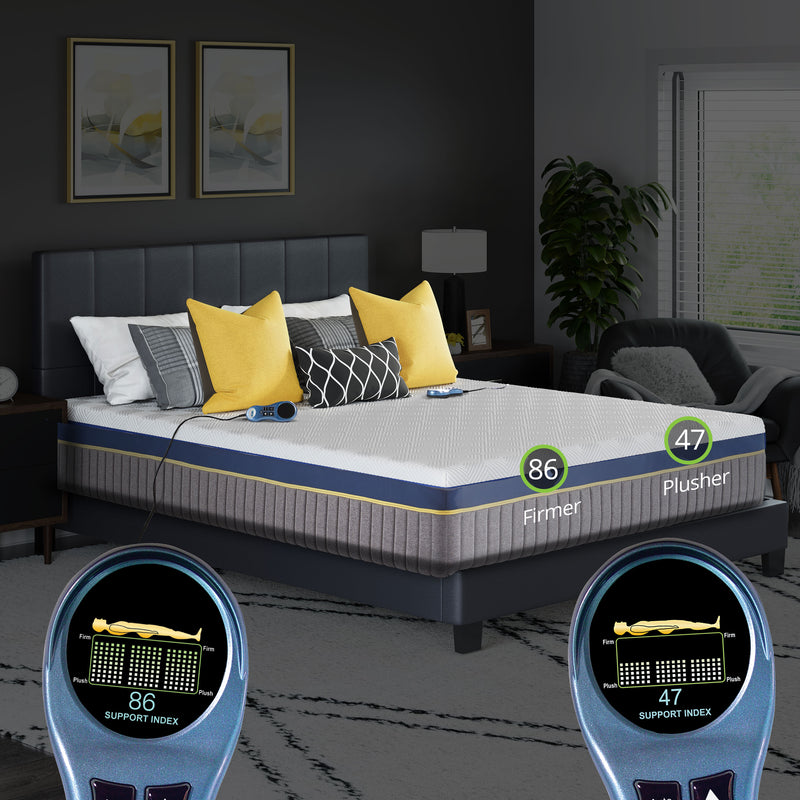
Supreme · 2-Zone
Two independently adjusted sides (one air chamber for each sleeper). Each person chooses their own 1-to-100 support setting, but cannot separately increase only the lumbar area within that side.
Useful for couples with different overall firmness preferences. Product photo: Boyd Night Air.
Ultra · 6-Zone
Three independently adjustable areas per sleeper: one lumbar area and two head/foot areas, for six total. The separate center section permits targeted changes under the waist without using the same support level across the whole side.
Useful for different support needs along the body. No medical efficacy or pressure-map result is implied.
Night Air lineup compared
Manufacturer-listed starting prices observed October 10, 2026, not Queen-size price quotes or independent sale-price verification. Options, promotions and height can affect cost.
| Model | From | Profile | Main comfort layer | Best reason to consider |
|---|---|---|---|---|
| Supreme 10" 2-Zone | $999 | 10 inches | 1.5-inch comfort foam | Lowest-priced route to independently adjusting each side |
| Supreme 12" 2-Zone | $1,899 | 12 inches | 2.5-inch reversible Gellux engineered latex foam | Couples wanting more surface cushioning without lumbar zoning |
| Supreme 14" 2-Zone | $2,599 | 14 inches | 3.5-inch five-zone MicroTec gel memory foam | People who like a thicker, more contouring comfort surface |
| Supreme 16" 2-Zone | $3,299 | 16 inches | 4.5-inch seven-zone MicroTec gel memory foam; copper-infused cover | Shoppers seeking plush comfort above independent firmness adjustment |
| Ultra 11" 6-Zone | $1,999 | 11 inches | 1.5-inch comfort foam | Best entry into independently adjustable lumbar support |
| Ultra 12" 6-Zone | $3,049 | 12 inches | 2.5-inch Gellux engineered latex foam | More comfort foam with separate lumbar, head and foot settings |
| Ultra 14" 6-Zone | $3,499 | 14 inches | 3.5-inch MicroTec gel memory foam | More contouring and full six-zone adjustment |
| Ultra 16" 6-Zone | $3,999 | 16 inches | Premium gel foam and copper-cover options; confirm exact current configuration | Shoppers prioritizing a thick comfort stack and six-zone control |
The manufacturer's Ultra 16-inch listing contains inconsistent text about whether the top comfort layer is 3.5 or 4.5 inches; verify its current construction before purchasing. Listed prices may change.
How the air chambers, controls and foam work
Unlike a typical foam or coil mattress, Night Air relies on adjustable pressurized air chambers for primary support. You set the pressure with a wired LCD controller, while the foam comfort layer above the chamber determines much of the cushion, contouring and how quickly you feel support changes. A surrounding high-density foam tray adds structure along the edges.
Night Air advertises flexible TPU air cores for the Ultra 11 and a rubber air core for the Supreme 10; exact chamber and cover materials vary by model. The two included remotes do not require an app to make firmness adjustments. Some models arrive compressed and need assembly and expansion time, while other pages describe curbside freight delivery. Confirm the exact SKU's delivery details.
Setting a number is not the same as a standardized firmness score. A 40 on an air bed does not necessarily feel like a 4/10 on a fixed mattress; your weight, position and top comfort layer all matter. Expect a short period of experimentation to locate a comfortable setting.
Cooling, couples and sleeper fit
Cooling: the 12-, 14- and 16-inch options add brand-specific engineered latex or gel memory foams and Ice Lux cover variants. The manufacturer describes cooling benefits, but these claims are not Sleep Sage temperature measurements. The thicker foam options may also change how much heat is retained at the surface.
Couples: each side has its own adjustment settings, solving one common firmness disagreement. That does not ensure zero motion transfer: the foam bridging both sides and shared frame can still transmit movement, and the pump's sound has not been measured by Sleep Sage.
Side, back and stomach sleepers: side sleepers often need more cushioning around the shoulder; the thicker top-layer options may help. Back and stomach sleepers may prioritize easy hip and lumbar adjustments. For the six-zone units, independent lumbar adjustment may allow more tuning, but no single setting is universally correct or a treatment for pain.
Trial, returns and warranty: read this before buying
100-night trial with conditions: Boyd's written terms require at least 30 nights of sleep and accepting one comfort enhancement arranged by the brand before a qualifying comfort return. A qualifying return still deducts $99 for shipping returned components. A nonqualifying comfort return may incur a $199 fee. The company can also offer one mattress exchange. Power bases and accessories are excluded. Do not mistake the marketing term “risk-free” for a no-fee return.
Warranty is model-specific: the Supreme 10-inch currently lists a 15-year limited warranty and the Ultra 11-inch lists a 20-year limited warranty. Boyd's general warranty policy also describes 20-year coverage for non-closeout beds and a shorter 10-year closeout schedule, with differing trade-in credit percentages as the bed ages. Check your chosen model's written coverage, particularly for pumps, hand controls and air chambers.
California delivery exception: the seller's free shipping fine print excludes California, Alaska and Hawaii. Since shipping cost could materially change the value calculation, enter your ZIP code before treating any advertised price as the final total.
Night Air vs. Sleep Number: what is comparable?
These are independent brands offering mattresses with variable air-chamber support. The most distinctive Night Air choice is its six-zone series, which independently controls the lumbar area and head/foot areas on each half. A basic two-zone Night Air more directly competes with adjustable air beds that use one chamber per side.
Compare the actual model you would buy, including top-layer thickness, setup, service availability, user interface, exchange requirements and final delivered price. Boyd's comparison tables include older Sleep Number prices from 2023, which should not be treated as a current price comparison.
Frequently asked questions
Is Night Air the same company as Sleep Number?
No. Night Air is Boyd Sleep’s own adjustable-air mattress brand and is not affiliated with Sleep Number. Both sell beds that vary air pressure, but model designs and warranties differ.
What is the difference between Night Air 2-Zone and 6-Zone?
Two-Zone has a separately adjustable air chamber for each side of the bed. Six-Zone separates each side into head/foot and lumbar adjustment areas, giving three controllable areas per sleeper, six in total.
Does Night Air need Wi-Fi or a phone app?
The models reviewed use included wired LCD hand controls with settings from 1 to 100. The company does not require a phone app for these documented controls.
Does Night Air have a risk-free 100-night trial?
Not completely risk-free. Night Air publishes a 100-night trial for eligible purchases, but requires at least 30 nights of use and acceptance of one comfort enhancement before a qualifying comfort return. A qualifying return still deducts $99 for shipping of mattress components; otherwise $199 may be deducted. Accessories and power bases are excluded.
Is shipping free to California?
The retailer’s current delivery fine print explicitly excludes California, Alaska and Hawaii from the free-delivery offer. Confirm the shipping total before checkout.
How long is the warranty?
It is model-specific. The Supreme 10-inch product page advertises a 15-year limited warranty; the Ultra 11-inch lists 20 years, while the general warranty page also describes 20-year non-closeout and 10-year closeout schedules. Read the exact model and sale designation before buying.
Are the Night Air models good for back pain?
The six-zone layout lets a sleeper fine-tune lumbar air pressure separately, but that is a comfort-adjustment feature, not evidence that the bed treats back pain. Persistent symptoms deserve individualized medical guidance.
Has Sleep Sage tested Night Air beds?
No. This review is an editorial research evaluation of the manufacturer’s published products, policies and construction. We have not slept on them or completed lab measurements of temperature, motion, pressure or pump noise.
Bottom line
Night Air is worth considering if you share a bed with someone who prefers a different support level or you specifically want adjustable lumbar firmness. Look first at the Supreme 10 if you need basic dual firmness and at the Ultra 11 if fine lumbar control is the point. The bigger foam stacks can improve surface plushness, but they make the total purchase more expensive. Because returns are conditional and charges apply, verify the exact model's warranty and delivered cost before paying.
Shop Night Air via Sleep SageManufacturer sources, accessed October 10, 2026
* We may earn a commission through affiliate links. This doesn't affect our reviews.